Best power banks for power cuts: a UK buying guide
How much power you really need to keep phones running for a week without electricity, and how to spot unrealistic claims.
How we make money: The Stay-at-Home Store is run by the team behind The Home Prep Kit. We recommend features to look for, not specific competitor products, and we label links to our own kit.
How much capacity do you need?
| Capacity | Approx. Wh | Typical phone charges | Good for |
|---|---|---|---|
| 5,000mAh | 18.5Wh | About 1 | Handbag backup |
| 10,000mAh | 37Wh | About 2 | 1–3 days with careful use |
| 20,000mAh | 74Wh | About 4 | A week for one phone |
| 26,800mAh | 99Wh | About 5–6 | Largest common size under 100Wh |
Wh = mAh × 3.7V ÷ 1000. Real-world charges are lower than the headline because of conversion losses.
Buying checklist
- UKCA or CE mark and a UK importer or manufacturer address on the box
- Watt-hour rating printed on the case
- USB-C input and output (faster to recharge)
- Pass-through or LED charge indicator
- Realistic size and weight for the capacity claimed
Make your phone battery last
- Low-power mode on. Cuts background activity.
- Dim the screen. The screen is the biggest drain.
- Text, don't call. Texts get through more reliably and use less power.
- Charge in short bursts. Top up from 20% to 80% rather than 0 to 100.
Frequently asked questions
What size power bank do I need for a power cut?
For a day or two, 10,000mAh gives most phones two full charges. For a week, aim for 20,000mAh or two 10,000mAh banks, plus a solar or hand-crank backup. Larger is heavier and slower to recharge.
Are solar power banks any good?
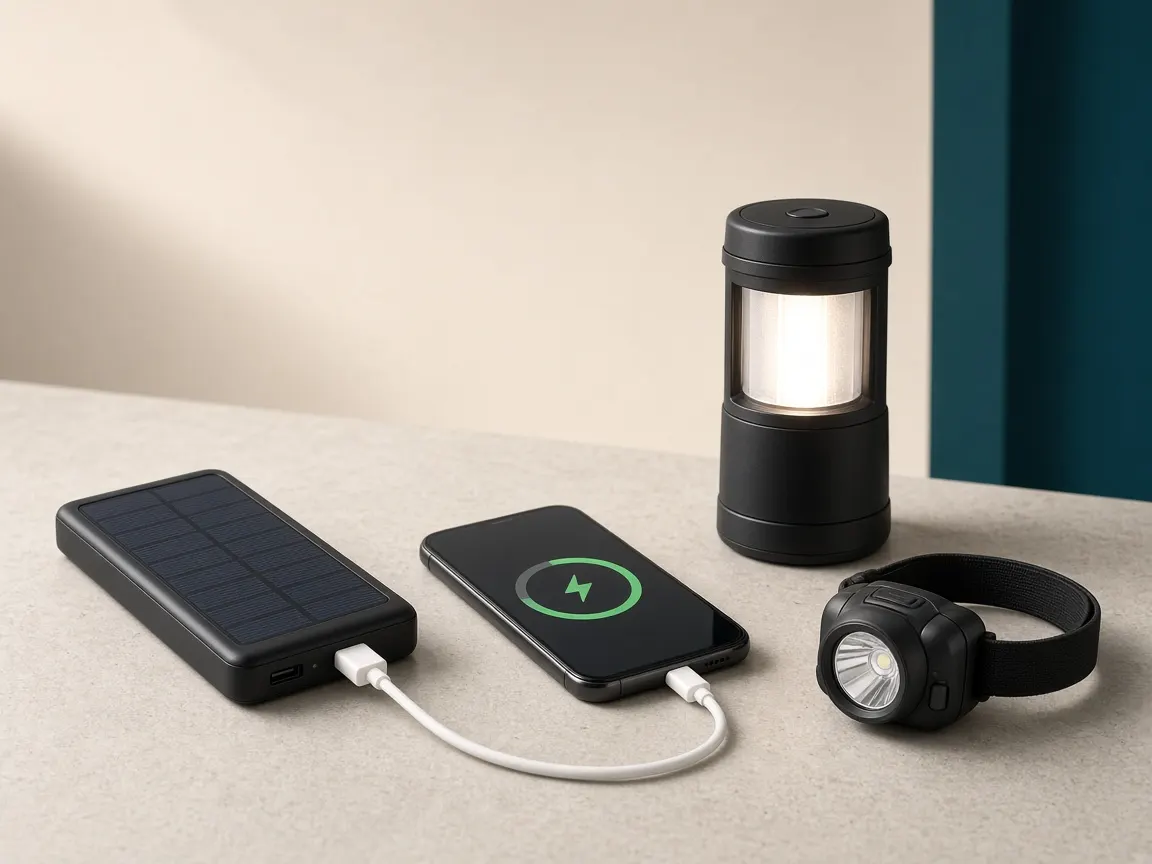
The small panel on a solar power bank charges very slowly, often taking days in UK daylight. Treat solar as a trickle top-up and charge the bank fully from the mains before you need it.
Can a power bank really be 50,000mAh?
Some cheap listings claim 50,000mAh or more in a pocket-sized case, which is usually unrealistic. A genuine 50,000mAh bank is large and heavy and is around 185Wh, above the 100Wh limit airlines and many couriers use. Check the watt-hour (Wh) rating on the label.
How do I keep a power bank ready for emergencies?
Charge it to full, store it somewhere cool, and top it up every 1–3 months. Lithium batteries slowly self-discharge.
Updated 2026-10-28.